A New and Intelligent World
and an introduction from me
Welcome to my first post.
I created this out of a place of ambition and passion. A place for me to log my professional research, record, as well as my informal thoughts.
I am 21. I have well over a hundred thousand dollars invested in the equity markets across the world. And as of right now, I am debating dropping out of college. Not because I want to do this for a living, but because we live in a world where anything is possible, and college, for the most part, has felt like more of a constraint than anything. But we’ll see. As this is my first post, this is not going to be an analytical or technical post but rather a personal one.
What began as a means of making money has evolved into something far more profound: the satisfaction of being right, the pursuit of ownership in exceptional businesses, and an ever-deepening desire to cultivate multidimensional critical thinking.
Since the time of my first long call five years ago, things have changed. The world beneath our feet has evolved at an extraordinary pace. And it’s our job as humans to evolve with it.
Artificial Intelligence is no longer some abstract technological frontier. It has become the fundamental driving force of economic output, labor productivity, and GDP growth. It is our job not just to anticipate the shifting tides, but to position ourselves accordingly.
With extreme simplification, the chart below illustrates reasoning in its most consequential, real-world form. Not a model’s ability to answer discrete questions on a test, but its capacity to carry complex, multi-step tasks through to completion on its own. That capability is measured by task length, which is the hours a skilled human professional would need to do the same work, at which a model succeeds half the time. This offers a practical lens on how quickly AI systems are evolving towards independent execution,
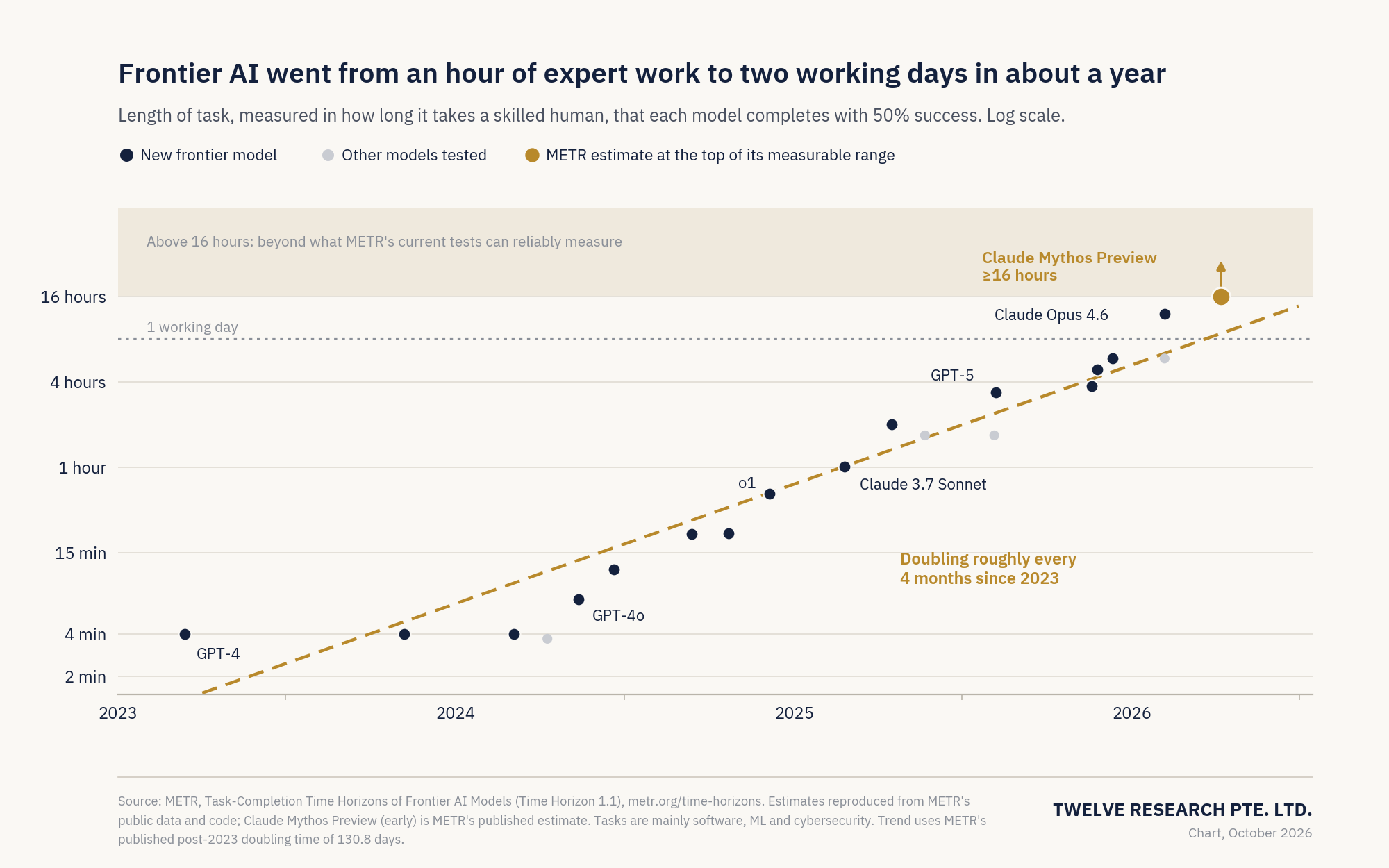
To put it simply. Evolve or get left behind. I am tired of hearing that we live in such a scary age, an age of unemployment, an age of “AI eating up jobs”. No. This is the most interesting day and age. It’s a rare time in history when you can create something without being judged. Not just that, but through the development and abundance of common intelligence, the gap between institutions and individuals narrows with each passing day. We have independent researchers building proprietary information systems and alternative price indices; solo developers deploying specialized AI agents and open-source models; small teams creating analytical platforms that would previously require capital and personnel of a bigger institution. This is the most interesting time to be alive.
In July, I worked with Dr. Anthony Watson and published an academic research thesis on Common Intelligence, where I explored what I believed to be a fundamental mispricing in the market. Equity markets are heavily penalizing asset-light software companies as they transition toward increasingly capital-intensive, infrastructure-dependent business models, doubting the long-term economics of AI. You can read it here.
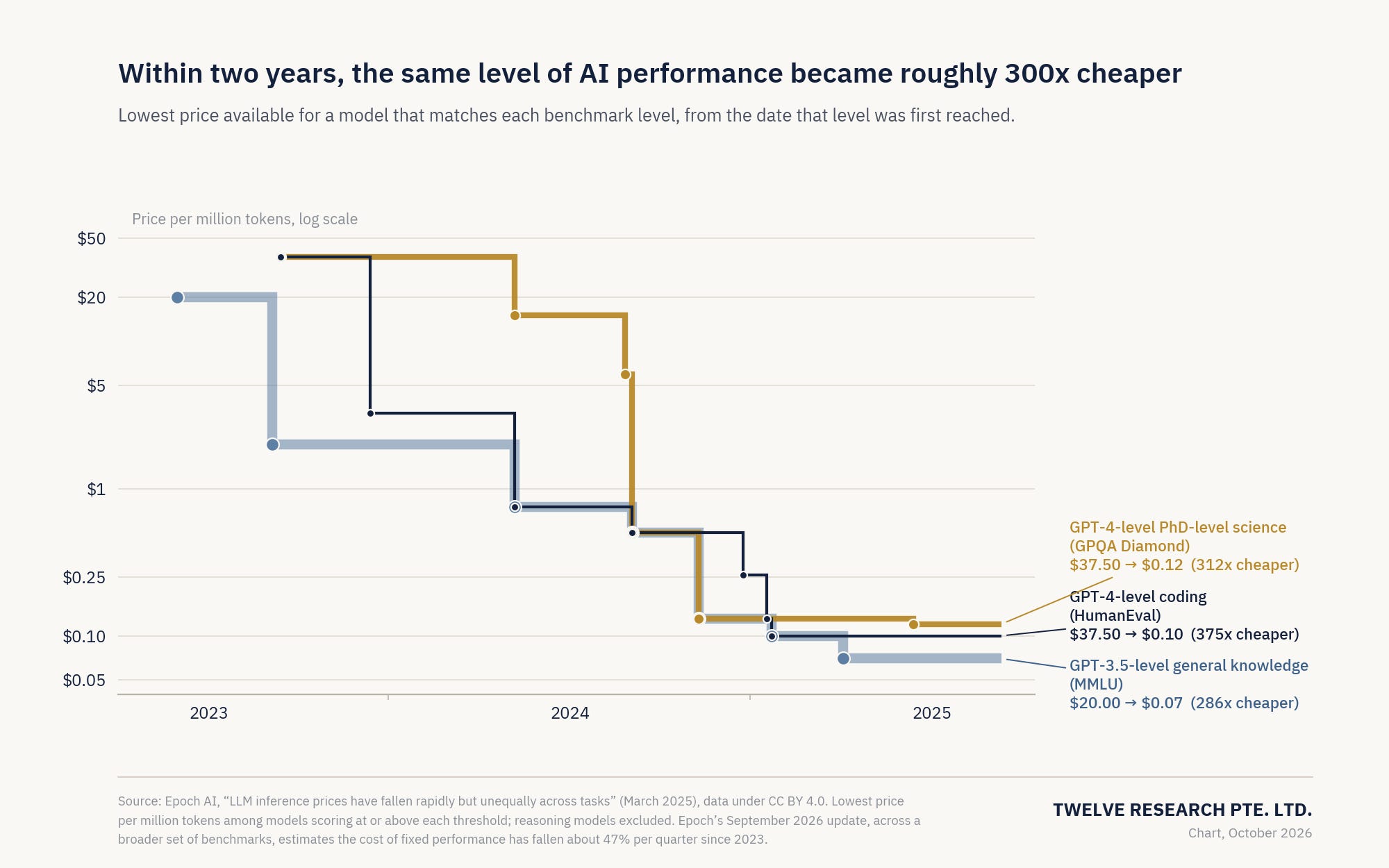
My central thesis is that intelligence will become a utility in how it is used and a commodity in how it is priced. Like water and electricity, it will be distributed at scale and embedded into the foundational operations of modern society, permeating schools, hospitals, military installations, government institutions, and enterprises of every kind. It will be an essential service and less of a selected product. And like any resource produced at that scale, its price will fall toward the cost of producing it, until one provider’s intelligence is largely interchangeable with another’s.
I refer to this as “Common Intelligence.” Its price is already collapsing. The cost of running an AI model has fallen roughly 47% every quarter since 2023, about thirteenfold a year. A commodity is a difficult business for the people who sell it, and when the product itself becomes cheap and interchangeable, the money moves to whoever controls what remains scarce: the chips, the power, and the data centers that intelligence runs on.
That scarcity is no longer theoretical. In August 2026, Texas paused new data center connections to its grid after requests to plug into ERCOT reached roughly 474 gigawatts, more than five times the state’s all-time peak demand, with about 90% of it coming from data centers. The buildout itself is slipping, with Sightline Climate estimating that 30% to 50% of the 16 GW of global data center capacity scheduled to come online in 2026 will be delayed or canceled, with only about 5 gigawatts actually under construction.
The companies building intelligence are responding the way utilities do. They do so by locking up power generation decades in advance. Microsoft signed a 20-year agreement to restart Three Mile Island. Amazon contracted up to 1.9 GW of nuclear power through 2042. Meta has lined up as much as 6.6 GW of nuclear capacity by 2035. These are not software contracts. They are the long-dated, capital-intensive commitments of an industry that is becoming infrastructure.
This is the thesis I’ve used to invest and trade over the past two years. But more investing than anything, it's because the economics of these companies are extremely attractive, and I am truly passionate about owning some of these companies at their current valuations.
This is just a brief overview. Welcome and thank you for reading. Over the coming weeks, I’ll get more technical about where we are in this current economic cycle and what this macroregime looks like.
The abundance of intelligence in this new world is not something to be underestimated. If you are young like me, take a leap of faith and start something big. If you are older, go learn a new skill you once thought was out of reach. How much can you really lose?
Martin
Twelve Research
https://twelveresearch.com